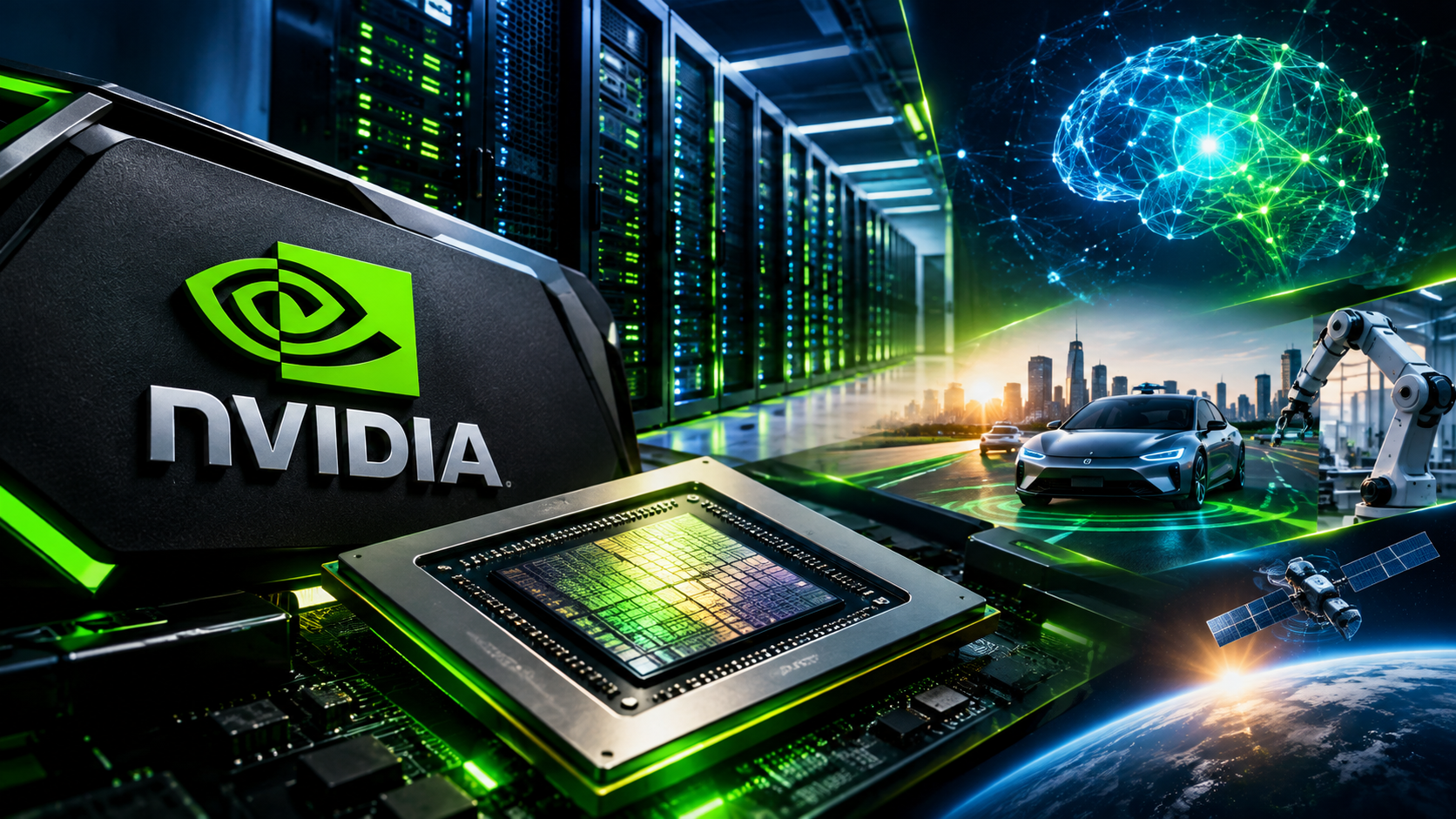
NVIDIA News continues to attract worldwide attention as artificial intelligence moves from an emerging technology into a major part of modern computing. NVIDIA has become one of the central companies behind this transformation, supplying the processors, networking technologies, software platforms, and complete computing systems used to develop and operate advanced AI applications. What makes the latest NVIDIA News: particularly significant is the scale at which demand for AI infrastructure continues to grow.
The company’s recent financial results show how rapidly this market is expanding. NVIDIA reported revenue of $96.2 billion for the second quarter of fiscal 2027, representing a NVIDIA News 106 percent increase from the same quarter a year earlier. Data Center revenue reached $89 billion, up 117 percent year over year. These figures demonstrate that AI infrastructure remains the primary engine behind NVIDIA’s business.
The significance of these numbers extends beyond NVIDIA News itself. Cloud providers, technology companies, research institutions, startups, automotive businesses, and enterprises are all investing in increasingly powerful computing infrastructure. As AI models become larger and AI applications become more sophisticated, the demand for accelerated computing has become a central issue across the technology industry.
NVIDIA’s strategy is also changing. NVIDIA News The company is no longer simply presenting itself as a graphics processor manufacturer. Its latest announcements increasingly focus on complete AI factories, networking, software, robotics, physical AI, quantum computing, and specialized infrastructure. This broader approach is shaping a new era in which computing performance depends on the interaction between chips, software, networking, memory, and massive data-center systems.
NVIDIA’s Financial Momentum Continues
One of the most important themes in current NVIDIA News is the company’s continued financial growth. The second-quarter fiscal 2027 results showed that NVIDIA generated $96.2 billion in quarterly revenue, compared with $46.7 billion in the same quarter of the previous fiscal year. Operating income increased 124 percent year over year to $63.7 billion, while net income reached $59.7 billion.
The results followed an already strong fiscal year. For the fourth quarter of fiscal 2026, NVIDIA reported quarterly revenue of $68.1 billion and full-year revenue of $215.9 billion. Data Center revenue reached $62.3 billion during that fourth quarter, demonstrating how heavily the company’s growth has become connected to AI computing.
The progression from those earlier results to NVIDIA News the latest quarter illustrates the extraordinary pace of expansion in AI infrastructure. NVIDIA’s revenue growth is not being driven by a single consumer product. Instead, the company is benefiting from demand for large-scale computing systems used to train AI models and increasingly to run AI applications after those models have been trained.
This distinction is important because NVIDIA News inference is becoming just as significant as training. AI systems are being used continuously by businesses and consumers, which means the industry requires enormous computing capacity not only to build models but also to serve them. NVIDIA has positioned its architecture around both sides of that process.
The Rise of Vera Rubin
Another major subject in NVIDIA News is the company’s Vera Rubin platform. NVIDIA has described Vera Rubin as a new platform designed for the next stage of agentic AI, with multiple chips and systems working together to support large AI factories.
The platform includes Vera Rubin NVL72 GPU racks, Vera CPU racks, Groq 3 LPX inference accelerator racks, BlueField-4 STX storage racks, and Spectrum-6 networking technology. NVIDIA says seven new chips associated with the platform have entered full production.
This represents a significant shift NVIDIA News in the way high-performance computing is being designed. Rather than treating the GPU as an isolated component, NVIDIA increasingly approaches the data center as a complete computing system. Processing, networking, storage, memory, and software all have to work together efficiently when thousands of processors are operating at the same time.
The importance of this approach becomes clearer as AI workloads become more complex. Traditional computing architectures were often designed around relatively predictable workloads, but modern AI systems can involve enormous models, large data sets, and continuous communication between processors. Faster individual chips are important, but the connections between those chips can be equally important.
Vera Rubin therefore represents more than another generation of processors. It reflects NVIDIA’s effort to build an integrated infrastructure platform capable of supporting increasingly demanding AI workloads.
Blackwell Remains an Important Part of NVIDIA’s Strategy
While Vera Rubin represents the next major stage of NVIDIA’s roadmap, the Blackwell generation remains an important part of the company’s current AI infrastructure business. NVIDIA has repeatedly highlighted Blackwell systems as key solutions for AI training and inference.
The company’s fiscal 2026 results described Grace Blackwell as an important platform for inference, while NVIDIA’s later financial results indicated that demand for its latest data-center systems remained exceptionally strong.
The transition between NVIDIA News generations is especially important in the AI industry because customers are building infrastructure that may operate for years. Data-center operators need to consider performance, energy consumption, networking, software compatibility, cooling, and total operating costs before deploying large numbers of systems.
NVIDIA’s strategy is to make each new architecture part of a broader platform rather than simply replacing an older GPU. This creates continuity for developers and data-center operators while allowing new hardware capabilities to be integrated into existing software environments.
AI Factories Are Becoming a New Computing Model
A recurring idea in recent NVIDIA News is the concept of the AI factory. Instead of viewing a data center simply as a collection of servers, NVIDIA increasingly describes AI infrastructure as a production system for intelligence.
The concept is based on the idea that data enters a computing environment, powerful processors transform that data through AI models, and the resulting outputs become useful products or services. In this framework, computing resources are not merely supporting business operations. They become an essential part of the product itself.
NVIDIA’s first-quarter fiscal 2027 results described the buildout of AI factories as a major infrastructure expansion and highlighted growing adoption of agentic AI across businesses.
The growing popularity of AI agents NVIDIA News could make this model even more important. AI agents can perform multi-step tasks, interact with software, analyze information, generate content, and assist with complex workflows. As companies deploy these systems at scale, demand for inference computing can rise significantly.
This is one reason NVIDIA is focusing so heavily on complete infrastructure. The future of AI may depend less on occasional model training and more on continuous, high-volume interaction between users, software agents, and computing systems.
NVIDIA and the Expansion of AI Infrastructure Financing
Another development receiving attention is NVIDIA’s involvement in financing the expansion of AI infrastructure. In August 2026, the company announced partnerships involving major financial institutions including Apollo, BlackRock, Blackstone, Brookfield, Goldman Sachs, and KKR.
NVIDIA said the partnerships were intended to establish independent compute financing platforms capable of mobilizing more than $500 billion in third-party capital over time for AI infrastructure development.
This development shows that the AI infrastructure boom is not only a technology story. It is also becoming a capital-intensive infrastructure story. Building modern AI data centers requires enormous investment in land, electricity, cooling systems, networking equipment, processors, and specialized facilities.
As AI demand grows, financing NVIDIA News models may become increasingly important. Technology companies can develop processors and software, but the physical infrastructure required to deploy them at global scale requires capital from many parts of the financial system.
For NVIDIA, participation in this broader ecosystem can help support the expansion of the market for its technology. The more AI infrastructure that is built, the greater the potential demand for processors and networking systems.
Competition Is Increasing Across the AI Chip Market
Although NVIDIA remains a dominant force in AI computing, current NVIDIA News also highlights a rapidly changing competitive environment. Companies such as AMD and specialized chip startups are working to capture portions of the AI hardware market, while major technology companies are developing custom processors for their own workloads.
Recent reporting has also highlighted Huawei’s efforts to expand its AI chip capabilities in China. Huawei has reported strong domestic demand for its Ascend processors and is working on future generations of AI chips. Reuters reported that Huawei plans to accelerate development of new products as China continues efforts to build a more self-sufficient AI computing ecosystem.
Competition is not limited to NVIDIA News processor performance. AI hardware companies increasingly compete through software ecosystems, networking, memory technology, developer tools, energy efficiency, and complete systems.
NVIDIA’s CUDA software platform remains an important part of its competitive position because developers have spent years building applications and workflows around NVIDIA’s ecosystem. This creates a level of software compatibility and familiarity that competitors must address as they attempt to gain market share.
At the same time, customers increasingly have reasons to consider multiple platforms. Large technology companies may prefer custom chips for specific workloads, while cloud providers may offer customers a mixture of processors depending on price, performance, availability, and workload requirements.
Demand for NVIDIA Computing Remains Strong
Recent developments in the cloud-computing market provide another indication of strong demand for NVIDIA hardware. Reuters reported in September 2026 that NVIDIA News Nebius planned another increase in prices for leasing certain NVIDIA chips through its pay-as-you-go model, citing strong demand for computing resources used to train and operate AI systems.
Pricing pressure in cloud infrastructure can provide useful insight into the relationship between supply and demand. When customers are willing to pay more for access to scarce computing resources, it suggests that AI workloads continue to require substantial capacity.
The situation also demonstrates why infrastructure providers are investing so aggressively. AI companies need large amounts of compute, while cloud operators want to provide enough capacity to serve that demand. NVIDIA sits at an important point in this ecosystem because its processors are widely used by AI developers and infrastructure providers.
However, the long-term market will depend on more than demand alone. The economics of AI computing will increasingly be measured through useful output, efficiency, energy consumption, and revenue generated by applications.
NVIDIA Is Moving Beyond Traditional Data Centers
NVIDIA’s ambitions extend beyond conventional cloud and data-center applications. The company has been expanding its presence in robotics, autonomous systems, automotive computing, edge AI, quantum computing, and other specialized areas.
One recent NVIDIA announcemen NVIDIA News t focused on CUDA-Q and the company’s efforts to expand its open-source platform for fault-tolerant quantum computing. NVIDIA said its CUDA-Q Logical orchestration layer is designed to help researchers and developers design and test applications for future quantum systems. The company also reported that Fermilab used the platform to accelerate certain architectural development work.
Another emerging area is space computing. NVIDIA has introduced technology designed for AI processing in environments where size, weight, and power are tightly constrained. The company’s Space-1 Vera Rubin Module, IGX Thor, and Jetson Orin technologies are part of this broader direction.
These developments show how NVIDIA is attempting to make accelerated computing useful across increasingly diverse environments. AI is no longer limited to massive cloud facilities. Processing is gradually moving closer to vehicles, robots, industrial equipment, telecommunications infrastructure, and specialized machines.
NVIDIA and the Future of Physical AI
Physical AI is another important theme in recent NVIDIA News. The term generally refers to AI systems that interact with the physical world through robots, vehicles, industrial machines, and other devices.
NVIDIA has invested heavily in platforms that allow developers to train and deploy AI models for these applications. The company’s work in robotics and autonomous systems is part of a broader effort to extend AI beyond screens and software.
The development of physical NVIDIA News AI could create another major market for accelerated computing. A robot operating in a factory, for example, may need to process visual information, understand its environment, make decisions, and control movement in real time.
This requires a different combination of capabilities than conventional cloud-based AI. Low latency, energy efficiency, sensor processing, and reliability become increasingly important.
The opportunity is significant, but development is also complex. Physical systems operate in unpredictable environments, and the consequences of errors can be more serious than errors in ordinary software applications. This makes testing, simulation, safety engineering, and reliable hardware particularly important.
NVIDIA’s Role in the Broader AI Economy
The latest NVIDIA News demonstrates that the company’s influence increasingly extends across the entire AI economy. Its processors are central to many AI data centers, while its networking products connect large computing clusters. Its software supports developers, and its platforms increasingly target robotics, autonomous systems, quantum research, and edge computing.
The company’s financial results NVIDIA News provide a clear indication of how much economic activity is being built around AI infrastructure. NVIDIA’s fiscal 2027 second-quarter revenue exceeded $96 billion, while Data Center revenue represented the overwhelming majority of the quarter’s business.
That concentration creates both opportunities and challenges. Strong AI infrastructure demand can support continued growth, but it also means NVIDIA is closely connected to the pace of AI investment by a relatively concentrated group of major technology and infrastructure customers.
The industry is also becoming more competitive. Custom chips, alternative accelerators, networking companies, and new AI architectures are all developing rapidly. Customers have increasing choices, even as NVIDIA continues expanding its own platform.
What the Latest NVIDIA News Means for the Technology Industry
The broader significance of NVIDIA News is that computing itself is being redesigned around artificial intelligence. Traditional processors remain essential, but AI workloads require enormous parallel processing capability, fast memory, high-speed communication, and specialized software.
NVIDIA’s approach reflects this transformation. Instead of focusing solely on individual chips, the company is building integrated platforms that connect processors, networking, storage, software, and data-center infrastructure.
The emergence of Vera Rubin reinforces this direction. Its design combines multiple components into a larger system intended to support the next generation of AI workloads.
Meanwhile, NVIDIA’s financial results suggest that customers are continuing to spend heavily on AI infrastructure. Whether this level of investment remains sustainable over the long term will depend on the economic value created by AI applications.
That question will become increasingly important as companies move from experimentation to deployment. Businesses will ultimately want AI systems that reduce costs, increase productivity, create new revenue, or provide capabilities that were previously impossible.
The Road Ahead for NVIDIA
Looking ahead, NVIDIA’s next phase will likely involve a combination of hardware innovation, software development, infrastructure expansion, and deeper partnerships across the technology industry. Vera Rubin represents an important part of the company’s hardware roadmap, while its broader AI factory strategy aims to provide the infrastructure needed to operate increasingly complex AI systems.
At the same time, NVIDIA will NVIDIA News have to navigate competition, supply-chain requirements, changing customer preferences, export restrictions, energy demands, and the rapid evolution of AI models.
The company’s recent performance shows that demand remains powerful. Its second-quarter fiscal 2027 revenue increased 106 percent year over year, while Data Center revenue grew 117 percent.
However, the future of NVIDIA will ultimately depend on how effectively the company continues adapting to a market that is changing at extraordinary speed. AI models are becoming more capable, inference workloads are expanding, and computing is spreading into new areas such as robotics, autonomous machines, quantum research, and space.
NVIDIA’s strategy is increasingly built around that wider transformation rather than around GPUs alone. This broader vision is what makes the latest NVIDIA News especially relevant to the future of technology.
A Bold New Era of Style and Performance
NVIDIA is entering a period in which performance is no longer measured simply by how fast a single processor can operate. Modern AI computing depends on entire systems working together, from processors and memory to networking, software, cooling, and data-center architecture.
The latest NVIDIA News reflects this changing reality. Record financial results, the expansion of AI infrastructure, the transition toward Vera Rubin, growing inference demand, and investments across emerging computing markets all point toward a technology landscape increasingly shaped by accelerated computing.
The next chapter will involve more than faster chips. It will involve smarter infrastructure, broader AI adoption, new forms of computing, and closer integration between digital intelligence and the physical world. NVIDIA is positioning itself at the center of that transition, while competitors and customers continue shaping how the AI industry develops.
As artificial intelligence becomes a fundamental layer of modern computing, NVIDIA’s ability to innovate across hardware, software, networking, and complete systems will remain an important story to watch. The continuing flow of NVIDIA News therefore offers a useful window into a much larger transformation taking place across the global technology industry.